
Beyond the Shortage: Construction Equity
Ebba Schmidt and Sharon Latson join Natasha Ozybko to dismantle the labor shortage myth and introduce their revolutionary construction incubator, Big Shoulders.
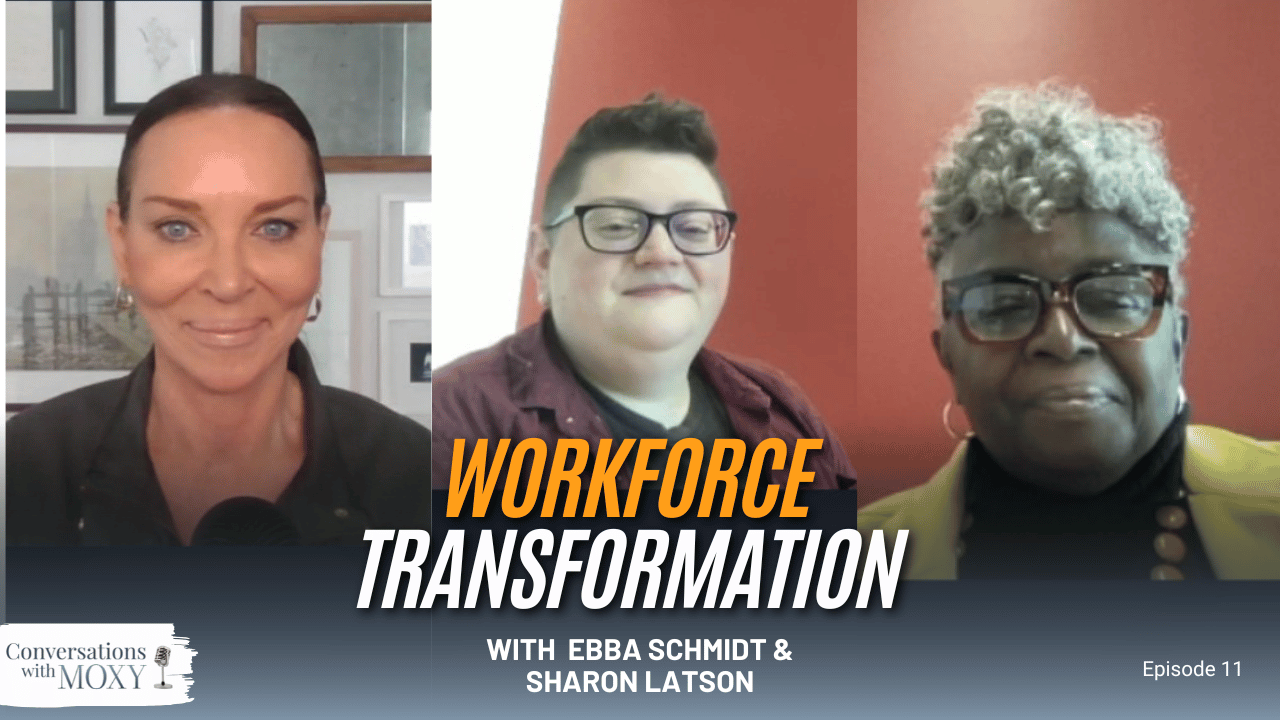
In this eleventh episode of Conversations with MOXY, host Natasha Ozybko talks with Ebba Schmidt and Sharon Latson, co-founders of Punch List Consulting. The discussion explores how these two former non-profit leaders are reframing the construction industry’s narrative from one of "labor shortages" to one of "systemic inequity," while providing the technical and emotional tools necessary for women and people of color to transition from workers to business owners.
A "Guided" Connection
Natasha Ozybko opens the episode with a personal story about the profound impact Sharon Latson had on the launch of MOXY in 2021. On the morning the platform was set to go live, Ozybko and her partner, Monica Dutcher, realized they had forgotten to upload a critical list of 70 supporting organizations. In a moment of panic, Ozybko glanced at the television to see Sharon Latson being interviewed on Good Morning America alongside President and Mrs. Obama regarding a diverse workforce partnership. This "sign" reaffirmed the mission of MOXY and established an early, spiritual link between the platform and the founders of Punch List Consulting.
From the Field to "Selling Humanity"
Ebba Schmidt’s journey is rooted in the trades as a former union carpenter and mill cabinet maker. After years in the field, she transitioned to a workforce coordinator role at Chicago Women in Trades (CWIT), where she describes her primary task as "selling humanity". Schmidt faced the heart-wrenching reality of convincing contractors to hire qualified women, only to see them occasionally used for "photo ops" and laid off shortly after.
Sharon Latson served as the Director of Marketing and Communications at CWIT, focusing on diverse workforce requirements for high-profile projects like the Obama Presidential Center. Realizing they could do more as entrepreneurs, the two founded Punch List Consulting to serve as a marketing, communications, and PR agency dedicated to elevating a diverse workforce at a systemic level.
The Myth of the Labor Shortage
The core of the guests' advocacy is found in their article, "There Is No Labor Shortage, Just Inequity". They argue that the infrastructure sector is not lacking people; it is lacking the willingness to hire beyond a narrow, traditional demographic.
The "Mozzarella" Analogy: Schmidt notes that the industry is "demanding mozzarella in a cheese shortage" by only looking for straight white males, rather than hiring the "cheddar"—qualified women and people of color who are sitting at home today waiting for a call.
Systemic Roadblocks: The guests highlight that women are often dismissed as "not strong enough" or "too emotional," stereotypes they categorize as archaic and damaging to the bottom line.
Business Imperative: With the infusion of capital from the Biden infrastructure bill, the guests warn that companies must either diversify or "shut their doors" because they simply won't have the bodies to perform the work.
Incubating the Future: "Big Shoulders"
To provide a concrete solution to these inequities, Punch List Consulting is developing the Big Shoulders Construction Campus in Chicago. This project aims to turn an older school building into a massive construction training and business incubator facility.
One-Stop Shop The campus will house multiple non-profits for technical training while providing an "incubation" area where emerging contractors can access insurance, bonding, and legal resources.
Professionalizing the Transition Latson emphasizes that new contractors often lack the professional infrastructure to win large bids. The campus will offer co-working spaces and professional addresses so small MBE (Minority Business Enterprise) and WBE (Women’s Business Enterprise) contractors can meet partners in a professional setting rather than a local coffee shop.
Communications Coaching Recognizing that technical skill doesn't always translate to business leadership, the team includes a communications coach to help new owners develop their "owner's pitch" and networking skills.
Conclusion: Intent vs. Impact
Sharon and Ebba conclude by urging senior leaders to evaluate the gap between their intent and their impact. While many leaders intend to be inclusive, their actual impact is often undermined by "checked boxes" and a failure to protect marginalized workers from toxic field environments. By treating "respect as an action verb," the industry can move past the "inclusion illusion" and build a 20-year plan that ensures the construction sector remains lucrative and viable for the next generation.