
Daily Dignity:Engineering Better PPE and the "Coverall Story"
Geotechnical engineer Melissa Kober-Meier joins Natasha Ozybko to discuss her journey from remote field work to inventing an innovative "trap door" coverall alteration for women
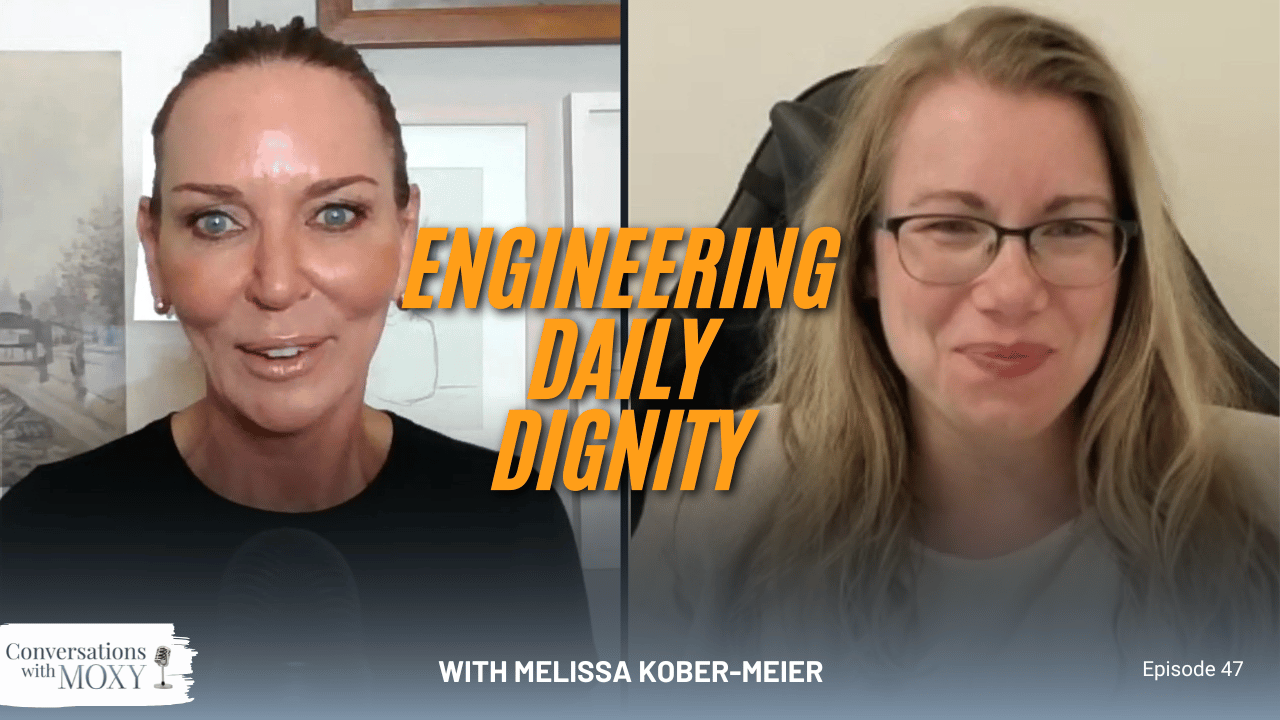
In this forty-seventh episode of Conversations with MOXY, host Natasha Ozybko interviews Melissa Kober-Meier, a geotechnical engineer and entrepreneur from Edmonton, Alberta. The discussion explores Melissa's transition from a frustrated engineer on a remote job site to an inventor solving a pervasive problem for women in infrastructure: the lack of functional and dignified personal protective equipment (PPE).
The Breaking Point: A Coverall Story
Melissa’s journey began with a humiliating and impractical experience common to women in the field. While working as a new engineer on a remote prairie field site in Alberta, she faced a basic human challenge—the lack of an actual bathroom. Tasked with working from 6:00 AM, Melissa was told to "peel off" her coveralls and "duck down" in waist-high grass because there were no porta-potties or trees for cover. Despite being fresh out of school and eager to solve problems, Melissa’s early attempt to introduce a simple solution—a five-gallon bucket with a toilet seat and a privacy tent—was laughed off by her male manager, who saw no need for it because he didn't share the same struggle. Ten years later, while working in an office, Melissa overheard a female colleague mention she had accidentally "peed on herself" due to the difficulty of managing standard coveralls. This was her breaking point, leading her to finally pursue an idea she had sat on for a decade.
Engineering a Solution: Never Be Nude On Site
Melissa leveraged her background in engineering and a family legacy of tailoring to create an innovative alteration for flame-resistant (FR) coveralls. Traditional coveralls require the wearer to unzip the front and peel the entire garment down to their knees, exposing them to extreme elements like -40°C temperatures or mosquito infestations. Melissa designed a discreet "trap door" alteration that unzips at the waistline, hidden under the waistband. This allows the wearer to perform daily functions without removing the top half of their gear or exposing their body on a job site. While born from a female necessity, the alteration is also beneficial for men, providing increased efficiency and dignity for everyone in the field.
The Business Case for Daily Dignity
The conversation emphasizes that providing proper PPE is not about "vanity" or "fashion," but a critical component of safety and retention.
Staggering Statistics Preliminary global survey data shows that 66% of women feel ill-fitting PPE hinders their ability to do their job safely, and 40% have experienced an injury or incident caused by poor fit.
The Loyalty Factor Natasha and Melissa note that women are chronically under-represented in senior leadership but are highly loyal when treated well. Providing gear that ensures daily dignity is a simple, effective tool for attracting and retaining the female talent needed to solve the industry’s labor shortage.
Conclusion: "I Can Do That"
Kober-Meier concludes by encouraging women to embrace their own "I can do that" gene. She urges industry leaders to recognize that "daily dignity" on-site isn't a luxury—it is the foundation of a productive and inclusive workforce. Her journey proves that when technical expertise is combined with radical empathy, even a decade-old "pipe dream" can transform into a solution that brings safety and respect to every worker in the field.